EDGAR DALE'S CONE OF EXPERIENCE
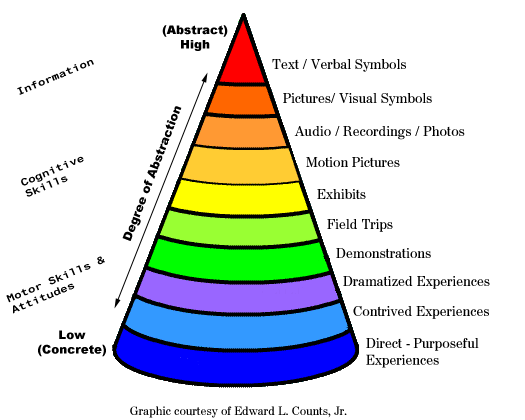
Dale’s Cone of Experience is a visual model that is composed
of eleven (11) stages starting from concrete experiences at the bottom of the
cone then it becomes more and more abstract as it reach the peak of the cone.
Also, according to Dale, the arrangement in the cone is not based on its
difficulty but rather based on abstraction and on the number of senses
involved. The experiences in each stages can be mixed and are interrelated that
fosters more meaningful learning.
According to one of the principles in the selection and use
of teaching strategies, the more senses that are involved in learning, the more
and the better the learning will be but it does not mean that concrete
experience is the only effective experience that educators should use in
transferring knowledge to the learner. Like what was mentioned above, the
experiences in each stages can be mixed and are interrelated thus, a balance
must be achieved between concrete and abstract experiences in order to cater the
and address all the need of the learner in all the domains of development and
in order to help each learner in their holistic development.
Moreover, the generalization about the Cone of Experience
that was presented above is not enough. Actually, we should try to go deeper in
each of the component of the cone since Educational Technology basically
revolves around the Cone of Experience. By going one-by-one, starting from
concrete to abstract, we will understand more the different components of the
cone that will help us in grasping the real meaning of educational technology.
To expand on each of the components, let us begin with the
Direct Purposeful Experiences. These are first hand experiences which serve as
the foundation of learning. In this level, more senses are used in order to
build up the knowledge. Also, in this level, the learner learned by doing
things by him/herself. Learning happens through actual hands-on experiences.
This level explains and proves one of the principles in the selection and use
of teaching strategies, the more senses that are involved in learning, the more
and the better the learning will be. This level also proves that educational
technology is not limited to the modern
gadgets and software that are commercially available nowadays. This shows that
even the simple opportunity that you give to each child could help them learn.
The next level would be the Contrived Experiences. In this
level, representative models and mock-ups of reality are being used in order to
provide an experience that as close as reality.
This level is very practical and it makes learning experience more
accessible to the learner. In this stage, it provides more concrete
experiences, even if not as concrete as direct experiences, that allows
visualization that fosters better understanding of the concept.
On the other hand, the next level would be the Dramatized
experiences. In this level, learners can participate in a reconstructed
experiences that could give them better understanding of the event or of a
concept. Through dramatized experiences, learners become more familiar with the
concept as they emerge themselves to the “as-if” situation.
The next level would be the Demonstrations. It is a
visualize explanation of important fact, idea, or process through the use of
pictures, drawings, film and other types of media in order to facilitate clear
and effective learning. In this level, things are shown based on how they are
done.
Another level would be the Study Trips. This level extends
the learning experience through excursions and visits on the different places
that are not available inside the classroom. Through this level, the learning
experience will not be limited to the classroom setting but rather extended in
a more complex environment.
The level of study trips is followed by exhibits. It is a
somewhat a combination of some of the first levels in the cone. Actually,
exhibits are combination of several mock ups and models. Most of the time,
exhibits are experiences that is “for your eyes” only but some exhibits
includes sensory experiences which could be related to direct purposeful
experiences. In this level, meanings ideas ar presented to the learners in a
more abstract manner. This experience allows student to see the meaning and
relevance of things based on the different pictures and representations
presented.
The next levels would be the level of television and motion
pictures and sti8ll pictures, recordings, and Radio. I decided to combine these
two stages since it is re3lated to one another. Because of the rapid
development of the modern technology, a lot of people believe that Educational
technology is limited to these stages. They are not aware that these sages are
only a small portion of EdTech. For television and motion pictures, it implies
values and messages through television and films. On the other hand, still
pictures, recordings and radio are visual and auditor4y devices that can be
used by a lerner/group of learner that could enhance and extend lerning
experience
Lastly, I also chose to combine the last two levels because
they are used hand-in-hand. The last two levels would be the Visual symbolic
and Verbal symbolic. These two levels are the most complex and abstract among
all the components of the Cone of Experience. In the visual symbolic level,
charts, maps, graphs, and diagrams are used for abstract representations. On
the other hand, the verbal symbolic level does not involve visual
representation or clues to their meanings. Mostly, the things involved in this
level are words, ideas, pricicples, formula, and the likes.
After going through the different components of the Cone of
Experience, it could be said that in facilitating learning, we can use variety
of materials and medium in order to maximize the learning experience. One
medium is not enough thus if we can take take advantage of the other media.
There’s nothing wrong with trying to combine several medium for as long as it
could benefit the learners. Also, through the levels provided by the Cone of
Experience, it could be said that concrete experiences must be provided first
in order to support abstract learning.
Lastly, staying on the concrete experiences is not even ideal because
through providing abstract experiences to the learner, the more he/she will
develop his/her higher order thinking skills which is important for more
complex way of thinking and for dealing with more complex life situations.
Through understanding each component of the Cone of Experience, it could be
said that Educational Technology is not limited to the modern gadgets that we
have right now but rather it is a broad concept that includes all the media
that we can use to attain balance as we facilitate effective and meaningful
learning.

No comments:
Post a Comment